Saturday, January 9, 2016

It is Phalaenopsis amboinensis time!

One of my favorites has bloomed again, namely a phalaenopsis amboinensis. It is a favorite for two reasons. First, it has a lovely citrus fragrance, and second, it keeps putting up new flower spikes while keeping its previous flower spikes. With most phalaenopsis, the spike dies once its flowers drop. You might get two spikes at once if the phal is really happy, but usually there is just one. But the amboinensis keeps its spikes for a long time, which means that you get a more and more impressive show as time goes on. Eventually, an older spike can wither, but my plant currently has four or five that are still active.


Here is a close-up of a flower. They are not as showy as many of the hybrids, but that scent gives them a special charm all their own.

Wednesday, September 9, 2015

The Amazing Paphiopedilum

It seems like every year is a great year for my wine-colored Paphiopedilum. This year there have been over one dozen flowers from this plant! A few of the flowers have already faded, but as this photo shows, there are still plenty healthy ones left.

In a few months it will be time to repot this plant - I'll have to be extra careful not to damage any of the roots so that hopefully there will be an equally amazing set of blooms next year.


Tuesday, August 18, 2015

Rolling the Dice

At this point, most of the orchids I created from seed have bloomed. I previously commented on how some of the flowers were subtly different from each other. Well, two of the plants are very different from their siblings. One has very short distances between the flowers on its spike - so much so that the flowers are very crowded and they have opened at odd angles. Also, the color is quite different in that the red spots are almost nonexistent and the yellow background color is much more intense. Here are two pictures of that plant.


The other odd-ball has a branched spike. None of the other plants have this characteristic. Also, the flowers are much more spotted than on any other plant, and the yellow background color is less permanent - as the flowers have aged, the yellow has almost faded completely. It is striking how different these two plants are. I guess it is just a genetic roll of the dice; perhaps these plants are similar to the original parents somewhere back in the breeding history of this hybrid.


A few years back, I bought a Neofinetia falcata, and while it bloomed shortly after I bought it, I had not had any success in getting it to rebloom. It added several new fans of leaves, but no flowers. This year I decided to give it pretty much full sun, out on the deck in my back yard (Northern New Jersey). That turned the trick. I now have flowers from it. They are quite fragrant, but the fragrance is only evident at night. During the day the flowers have virtually no fragrance. This plant must be pollinated by some night-active insect. And judging from the long tubes on the flowers, that insect must have a rather long tongue.


Lastly, my Phalaenopsis amboinensis is in bloom as well. This one has a lovely citrus fragrance, which is produced during the day. It is definitely one of my favorites owing to that fragrance.


Friday, September 26, 2014

Paphiopedilum rothschildianum

I feel like I've been transported to a magical place where orchids grow in abundance, and in the most fantastic fashion. I have a Paphiopedilum rothschildianum which has been unproductive for a year or two. It never was entirely happy - even when it did flower, I'd get one or two blooms. This year however, the plant was repotted, and left on my deck in partial sun. Apparently, that was the key, as I got two spikes, one with two flowers and another with three. Here is a view of the whole plant.


Here is a better view of the flowers. They remind me of an old-time villain with a handlebar moustache. I'm sure the shape has evolved as a way to attract pollinating insects. Those long petals must really sway in the breeze.


And here is a single flower. They are really large, and have a very complex structure.


In profile, the flower looks quite alien, like some strange insect leg was grafted onto a flower.


One fine detail of the petals is that they have tiny black hairs going off in various directions. Right-sized to be noticed by small insects, even if they are a bit tricky for us humans to notice (and photograph).


Lastly, here is part of the flower where you can clearly see the pollen. In the center of the photo, notice a small oval structure with a red-orange rim. That is the pollen. Normally, an insect climbs into the flower pouch, which has a very waxy inner surface. Because of the small opening, the insect cannot easily fly out. The only method of egress is to climb up the rear inside surface of the pouch, which is rough, and not waxy. That path first takes the insect past the female part of the flower, the stigma. Then as the insect climbs higher, it passes the pollen, which adheres to the body of the insect. When said insect visits the next flower, the pollen is likely to be transferred to the stigma of that new flower. In this way, the orchid makes it much more likely that it will not be self-fertilized, thus improving the gene pool. Really a remarkable flower!

Thursday, August 28, 2014

Overachievers

This has been an amazing orchid season for me. My Paphiopedilum has gone to extreme lengths to impress. The plant has five spikes, and one of those has two flowers! There might have been another spike with two flowers, but only one flower developed properly. Still - six flowers from one plant, and all open at the same time. Amazing.

In addition, last time I repotted this plant, there was a baby that got disconnected, so I potted that plant up, and it has made a flower too. So, here are mother and daughter.

And, here is a close-up of the six flowers of the mother plant:

Not to be outdone, my white Phalaenopsis got in on the act, with roughly a dozen blooms. Since I individually carry my plants down to the basement once a week for water and fertilizer; this plant is a real handful to maneuver, without breaking the spike. But, so far I've been sufficiently gentle that no harm has come.

Here is an extreme close up of the center of the flower; while these flowers are certainly white, they have quite a bit of green in them. And from the back, they have traces of pink/purple.

Last but not least, I've finally gotten my Amboinensis to flower - it had been sulking for a while. I love this plant; it has a strong citrus fragrance, and even with its five fairly diminutive flowers, it perfumes most of the main floor of the house.

And here is a close view of one of those flowers. It has a particularly long "nose", and the petal/sepal shape is quite different from the common Phalaenopsis hybrids.

And while there are no flowers open yet, my two "Dancing Dolls" Oncidiums have each begun making one spike apiece. It will be a month or so before we have flowers from them.

Sunday, June 15, 2014

The Saga is Complete

As you may remember, I started raising some orchids from seed. I did this because the parent plant had a virus, and while viruses are incurable in orchids, the theory goes that orchids created from the seeds of said orchid will be virus-free. At least if you allow the seed pods to completely dry, rather than using so-called "green pod" seeds.

Anyway, the orchids I've been raising from seed have matured. It is now time to test them to see if they are virus free. And the answer is... YES!

Agdia makes an easy-to-use home virus test kit. You typically take about 150 mg of plant tissue, place it in a special bag containing a buffer solution, crush the tissue, and insert a test stick. Then, after 30 minutes, you examine the test stick, and read the results. Here is a photo of one of the test strips:


The bag contains the crushed tissue and fluid. The bags have an abrasive plastic mesh, which is what you use to crush the tissue. The test strip is inserted around 1/4" into the fluid. Notice that there is one red line visible on the strip. That is the control line, and it must be present for the test to be valid. There are no other red lines visible on the strip, so this plant is clean - no virus detected.

Sadly, another plant of mine, a "Sharry Baby" Oncidium, did test positive. Here is what that looks like:


Notice that in this case, there are two red lines visible. The line closest to the bottom indicates that this plant is infected with the Cymbidium Mosaic virus (CymMV). I don't feel like going on another five year mission to create clean babies from this plant, so I'll simply have to destroy it, buy a new one, and hope that it is virus-free.

But the bottom line is that the process of raising orchids from mature seed pods to eliminate viruses definitely does work. At least it did for me. Quite an adventure!

Saturday, April 5, 2014

Variations on a Theme

The "baby" orchids have made a lot of progress. This spring I have three separate plants in bloom at the same time. The interesting thing is that since they were grown from seeds, they are not identical clones. There are some very definite differences between them.

This one started out with a brighter yellow, but as the flowers matured, they became very pale yellow.

In the next one, the yellow is much brighter, and the pink/red spots are less distinct.

And lastly, we have one with much more intense red spotting.

So far, I've seen flowers from four of the dozen or so plants that I've kept. I'll be fascinated to see what else emerges. And no, I'm not expecting Audrey...

Saturday, December 14, 2013

Two-Fer

This is unusual - at least for me. I always thought of my Paph as making a single flower on a spike. Sure, there might be two or three spikes, if the plant was very happy, but this is the first time I've gotten two flowers on a single spike. So I guess this Paph can be a multi-floral if it has had an exceptional year.

Here is a close-up of the spike. Notice that there is a leaf-like structure part way up the spike, and then two thinner spikes come from there.

In other news, three more of the Phalaenopsis "babies" are putting up spikes, so soon we'll see if there is any variability in those flowers. They are hardly babies any more, really. But it will be a month or two before they are actually in bloom.

Sunday, March 10, 2013

The Trifecta

And the wait is over. We now have all three flowers open on our baby phalaenopsis:

And all the buds have opened on the pink phal as well:

Can Spring be far away? Sure hope not! The change of seasons will be very much appreciated.

Saturday, March 2, 2013

The Happy Family

This is certainly the time when orchids flower. I have four plants in bloom right now, and another four making spikes. Here is a group portrait of the ones in bloom:

The pendulant, white one is a Dendrobium Dilgry. This orchid has a fairly strong perfume; I definitely notice it when I walk past the plant. The fragrance is only apparent during the day. Once it starts getting dark out, the fragrance disappears.

Here is a close-up, showing a bit more flower detail.

And a final close-up. The flower is a cream to pale yellow color, and there is a bit of a color pattern in the center.

And here is the one we've been waiting for! The orchid, raised from seed, has fully opened two of its three flowers. The third bud is swelling, and will probably open in a week or so. The flower form is very nice, and the markings are quite distinct. I am thrilled to have been instrumental in this plant's entire life, from the initial pollination of the parent, right through flowering of the youngster.

My very first orchid is still with me, and in bloom. This is the one that started me on the road to orchid mania. It was touch and go when first I brought it home. The roots were not in great shape, but it managed to survive.

Here is a closer look at the lovely little red/brown freckles in the center of the flower.

Last, but not least, is a Paphiopedilum. This one has been a reliable bloomer, and holds it flower for months at a time. It has also split off a baby at repotting time. Baby is now making a spike, so even after this flower fades, there will be one right along to take its place.

Sunday, February 17, 2013

Say ahhhh!

And here we go! The very first bloom of the orchids I started from seed!

If you've been following along, the mother plant was pollinated around the beginning of 2009, and the seeds were sown in September 2009.

Fast-forward four years, and we have our first bloom. I am totally pleased with the results, as baby has even better defined patterning than momma did. I'll post more pics as the rest of the buds open. But I wanted to get this teaser out as soon as it began to open.

Altogether, I kept 24 plants from the original culture. None of the others has started spiking yet, although a few are probably getting close. So this particular plant is definitely the most precocious of the bunch.

Saturday, January 19, 2013

Buds! We have buds!

The tiny spike that I showed two months ago has been making excellent progress. In fact, we now have three well-formed buds. Given that I started from pollinating the mother plant back in early 2009, it has only been four years to get to this point.

Reminds me of a quote from "Duck Soup" by the Marx Brothers.

Treasury Secretary: "Sir, you try my patience!"
Firefly: "Don't mind if I do. You must try mine sometime."

Anyway... Here is a photo of the plant as of today:
Here is a picture that shows the underside of one of the leaves. The reddish color tells me that it is getting enough light. It also shows the label - the date indicates the last time it was repotted (October 2012).
In the next picture, you can see that I don't directly clip the spike to its support. I've damaged a few that way, so now I use some blue plastic (non-adhesive) tape along with a spring clip. The tape is specifically sold for tying up plants.
In this last picture, we simply have a close-up of the buds. They look very healthy to me. Hopefully, by next month we should get to see what they look like. I can't wait!

Saturday, November 17, 2012

The "Pepper" Orchid

I call this plant my "pepper" orchid, because the flowers have a subtle fragrance of black pepper. I don't know much about this plant, except that the seller said it was an Oncidium. It has a code number, but no name or parentage. I guess that it is a proprietary orchid hybrid. I have been gravitating to orchids with fragrance lately, so I was quite pleased to find one with such an unusual scent.

Now We're Getting Somewhere

The phalaenopsis that I started from seed have continued to grow very nicely. In fact, one of them has actually started making a spike! So in about a month I should see what the results of this experiment will produce. Here is a picture of the plant, with the spike circled in yellow:

 
And here is a close-up of the spike. We have a long way to go before flowering, but I am very excited to see all the preparation and work paying off.


Sunday, July 15, 2012

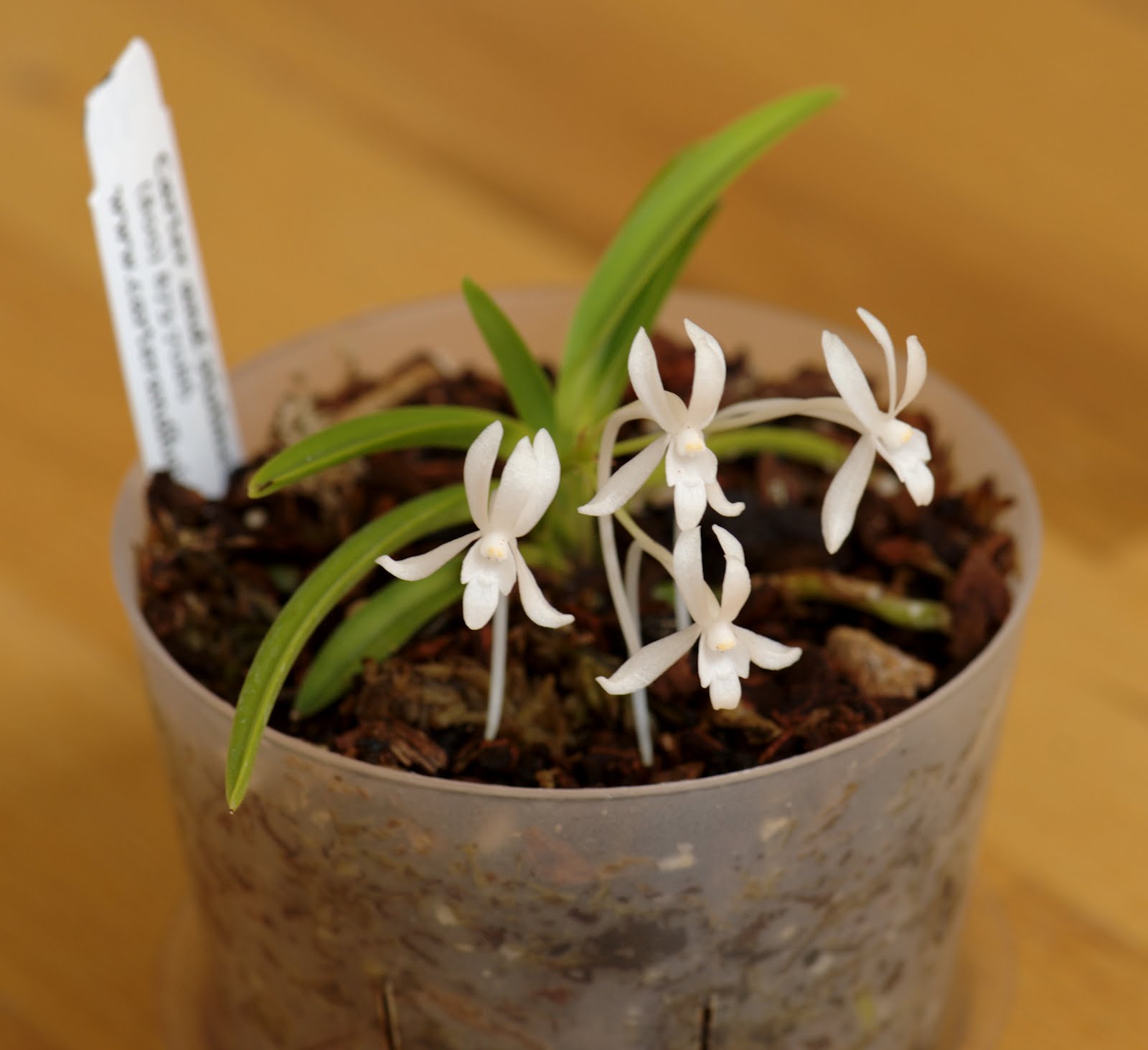
A miniature orchid - Neofinetia falcata

I am now growing a miniature orchid, called Neofinetia falcata. Here is a photo (as always, click on the photo to zoom in):

The fascinating thing to me is that the flowers have a long curved spur that is larger than the flower petals themselves. Notice the curved white tubes that come off the flowers and appear to go into the potting bark.
Here is another photo, with a US quarter in the picture to give a sense of scale. These guys are quite tiny. I'm impressed that they can bloom while so small:

One final picture, that shows the structure of the flowers a bit better:

I decided to do some close-ups of a few of the phalaenopsis that are in bloom right now. These are all unnamed hybrids. First, a spotted yellow phal:

The following one was sold as a blue phalaenopsis, which as far as is known does not exist in nature. The seller had injected blue dye into the stem, and the flowers did in fact appear blue when I bought the plant last year. This year, the flowers showed up in their correct natural color, namely white:

And finally, an extreme close up of a pink phal. I love the tiny red spots on the center of the flower.